If you’ve typed “is AI IELTS scoring accurate” into Google, you’re probably not looking for a philosophy lecture on machine learning. You’re deciding whether to trust an app’s Band 6.5 estimate on your Speaking or Writing practice test — or whether you’re wasting time on a number that means nothing when you sit the real exam.
I’ve spent a lot of that time also watching AI scoring tools try to do the analyzing job.
Short answer: the accuracy question isn’t yes/no — it depends heavily on which skill (Writing vs. Speaking), which model is doing the scoring, and what “accurate” is even being measured against. Let’s get into what the evidence actually supports.
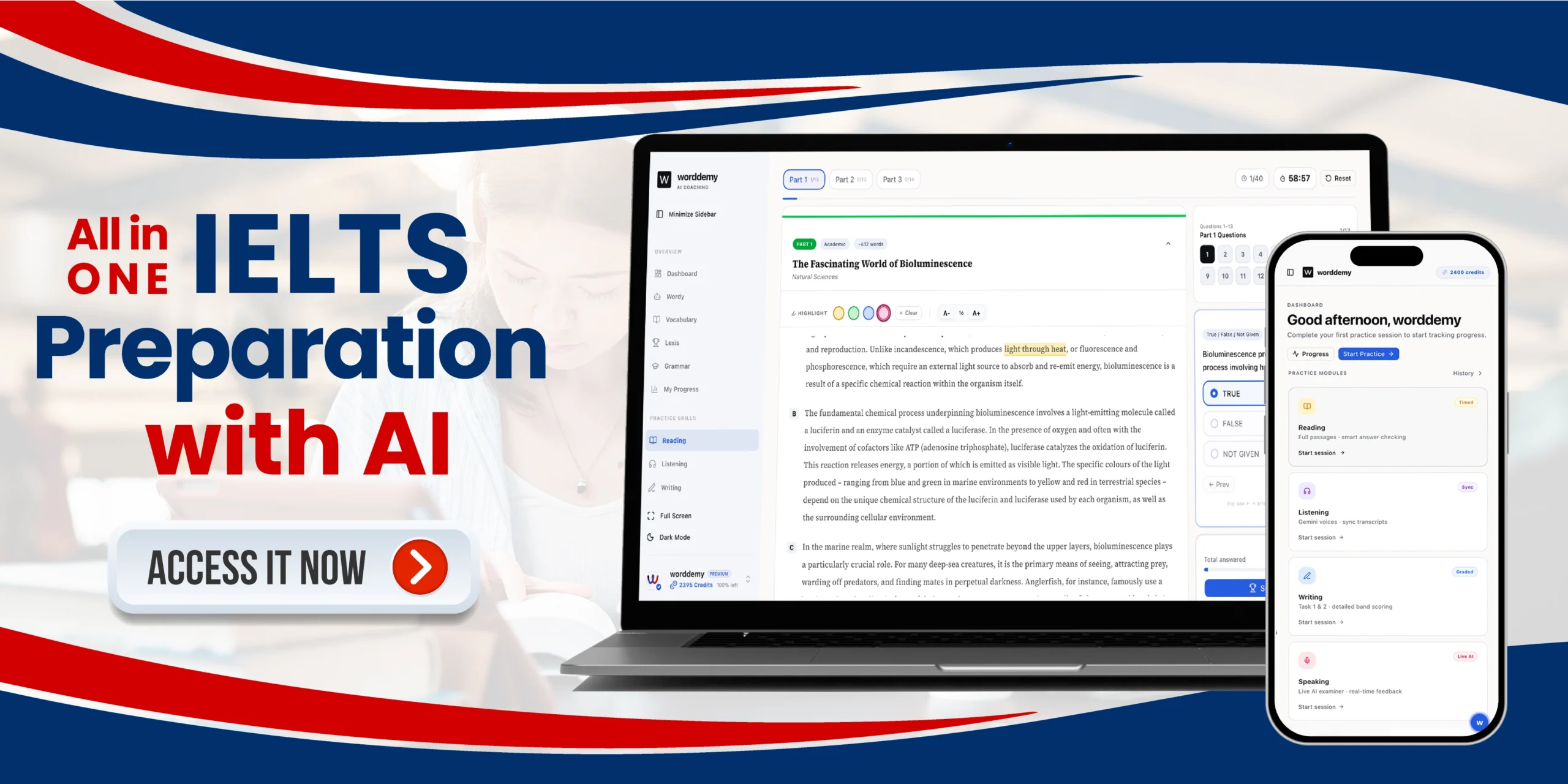
Worddemy, the AI IELTS prep platform I work with, is one option in this space — I’ll be upfront about where it holds up and where it doesn’t, alongside how competitors like Magoosh and PrepareBuddy approach the same problem.
Why This Question Matters More Than It Seems
A Band score estimate that’s off by even half a band changes your entire prep strategy. If an app tells you you’re at 7.0 when you’re really at 6.0, you’ll under-practice the fundamentals you actually need. If it tells you you’re at 6.0 when you’re really at 7.0, you might delay booking a test date you were already ready for.
So “accurate” here really means two things: (1) does the AI’s score correlate with what a real, certified examiner would give the same response, and (2) is that correlation strong enough — and consistent enough across band levels — to actually guide your prep decisions.
How AI IELTS Scoring Actually Works
Most AI scoring tools, Worddemy included, use large language models trained or fine-tuned against the four official IELTS band descriptors: Task Achievement/Response, Coherence and Cohesion, Lexical Resource, and Grammatical Range and Accuracy for Writing; Fluency and Coherence, Lexical Resource, Grammatical Range and Accuracy, and Pronunciation for Speaking.
The model isn’t “guessing” a number — it’s pattern-matching your response against thousands of examples of writing/speech that human examiners have already scored, then reasoning through each criterion the way a band descriptor asks an examiner to. The output you see (say, a 6.5 with a breakdown by criterion) is the model’s best estimate of where a human examiner would land, criterion by criterion.
This matters because it explains where AI tends to do well and where it doesn’t:
- Grammar and lexical range are relatively mechanical to assess — AI models are generally strong here, since they can spot error patterns and vocabulary sophistication reliably.
- Task Response/Achievement (did you actually answer the question, with a developed argument) requires more contextual judgment — this is where AI and human examiners diverge more often.
- Pronunciation in Speaking is the hardest for AI to assess well, because it depends on audio quality, accent familiarity, and features (like intonation and connected speech) that are harder to score from a transcript or even audio alone.
What the Published Research Actually Shows
This isn’t a fringe question — it’s been studied directly, and the results are more nuanced than a simple yes or no.
One study found GPT-4’s essay scores correlated with human raters at r = 0.731 at one testing point and r = 0.638 at a later one — researchers classified this as good reliability. For context, that’s in the same range as e-rater, a commercial automated scoring system that’s been benchmarked against human raters for over two decades at roughly r = 0.693 (Source: ScienceDirect, “Large language models and automated essay scoring of English language learner writing”).
A separate study fed 12,100 TOEFL essays through an early GPT model using IELTS Task 2 band descriptors as the scoring rubric, and concluded that generative AI could assess essays in reasonable alignment with the rubric — though not with perfect agreement to human raters (Source: ScienceDirect, “Can AI provide useful holistic essay scoring?”). That same body of research found a consistent pattern worth knowing if you’re relying on an AI score: AI models are less likely than human examiners to assign scores at the extreme ends of the band scale, which means very strong or very weak responses are the cases most likely to be scored conservatively toward the middle.
Not every study lands positive, either. One comparison of ChatGPT-3.5 against official IELTS examiners on pre-rated essays found ChatGPT-3.5 consistently scored lower than the human raters, with a large enough gap that the researchers concluded it wasn’t yet reliable enough for practical use on its own (Source: ResearchGate / Springer Nature, “Exploring ChatGPT as an Automatic Essay Scorer for IELTS Writing Task 2”). Meanwhile, newer models have consistently outperformed older ones in these comparisons, so which specific model sits behind an “AI feedback” feature matters more than most prep platforms advertise.
The takeaway from the research as a whole: modern LLM-based scoring can land in the same range as human examiners, particularly on Grammar and Lexical Resource, but it isn’t a solved problem — model choice, essay type, and how close a response sits to the middle of the band scale all affect how much you should trust a single AI-generated number.
AI Scoring Accuracy: Writing vs. Speaking vs. Reading/Listening
Reading and Listening are objectively scored (right/wrong answers against an answer key), so “AI accuracy” isn’t really a meaningful question there — the score is deterministic once you’ve selected your answers. The real accuracy question only applies to Writing and Speaking, which is why most of this article focuses there.
| Skill | How AI scores it | Where AI is strong | Where AI is weaker |
|---|---|---|---|
| Writing | Analyzes full text against 4 band criteria | Grammar, vocabulary range, structure | Nuanced task interpretation, register |
| Speaking | Analyzes transcript + audio features | Fluency markers, grammar in speech | Pronunciation, accent-sensitive scoring, natural hesitation vs. genuine struggle |
| Reading/Listening | Answer-key based | Fully objective, no accuracy question | N/A |
Is Worddemy the Right Fit for You?
Worddemy’s strength is instant, always-available feedback — you can submit a Writing Task 2 response at midnight and get a criterion-by-criterion breakdown in under a minute, which no human tutor can match on availability or turnaround. If you’re prepping on a tight timeline and need volume — dozens of practice essays or speaking responses reviewed quickly — that’s exactly the gap AI fills well.
If what you actually want is a human examiner-trained tutor catching subtle register and cultural-context issues in your writing, or working through pronunciation drills with real-time correction, a service with live human tutoring — or a hybrid approach — is a better fit for that specific need. Some competitors are worth knowing about here: Magoosh leans more into structured video lessons and a large practice-question bank rather than instant AI scoring; PrepareBuddy and similar platforms vary in whether their “AI feedback” is a lightweight scoring layer versus a fully trained band-descriptor model, so it’s worth checking their methodology pages directly, since not all “AI scoring” claims are built the same way.
Honestly, the strongest prep approach for most test-takers combines both: use AI feedback (Worddemy or similar) for high-volume practice and fast iteration, and get at least one or two sessions with a human examiner-trained tutor or teacher closer to your test date to catch what AI tends to miss.
Addressing the Real Hesitation: “Can I Actually Trust This Number?”
The honest answer is: treat any AI-generated Band score — from worddemy or any competitor — as a strong directional estimate, not a guarantee of your real exam result. It’s most reliable when:
- You’re tracking change over time (is my score trending up across 10 practice essays) rather than treating one score as gospel
- You’re using the criterion-level feedback (what specifically to fix) rather than fixating on the headline number
- You’re within a band or so of your target, where the model has more comparable training examples to draw from
It’s least reliable at the extremes (very low or very high band levels) and on borderline scores where human examiners themselves sometimes disagree with each other.
You can test this yourself without any commitment — Worddemy’s free AI Writing or Speaking assessment takes under 2 minutes to submit and gives you an instant Band estimate plus a criterion breakdown, so you can see exactly how it reasons through your own response before deciding whether to rely on it.
FAQ
Does AI IELTS scoring match my real test result exactly? No tool — Worddemy included — claims to replicate your exact official IELTS score. Think of AI scoring as a calibrated estimate for practice purposes, most useful for tracking progress and catching specific errors, not as a substitute for the real exam or an official mock test marked by a certified examiner.
Which IELTS skill is AI scoring most accurate for? Grammar and vocabulary assessment in Writing tends to be where AI performs most consistently. Speaking pronunciation scoring is generally the least reliable area across AI tools, since it depends on audio quality and accent-sensitive judgment that’s harder to model.
Is free AI IELTS feedback as good as paid tutoring? They serve different purposes. Free AI feedback (like Worddemy’s instant assessment) is strong for fast, high-volume practice and catching mechanical errors. It doesn’t replace the nuanced, contextual judgment a human examiner-trained tutor brings, especially for borderline band scores or nuanced task interpretation.
Try it yourself: Submit one Writing or Reading response to Worddemy’s free AI assessment — no credit card required — and see your Band estimate and criterion breakdown in under 2 minutes.