If you’re weighing an IELTS prep app against a human tutor, you’re not asking which one is “better” in the abstract — you’re asking which one gets you from where you are now to Band 7 with the time and money you actually have.
That’s a fair question, and the honest answer is: it depends on what’s currently holding your score back, and the two approaches aren’t actually competing for the same job.
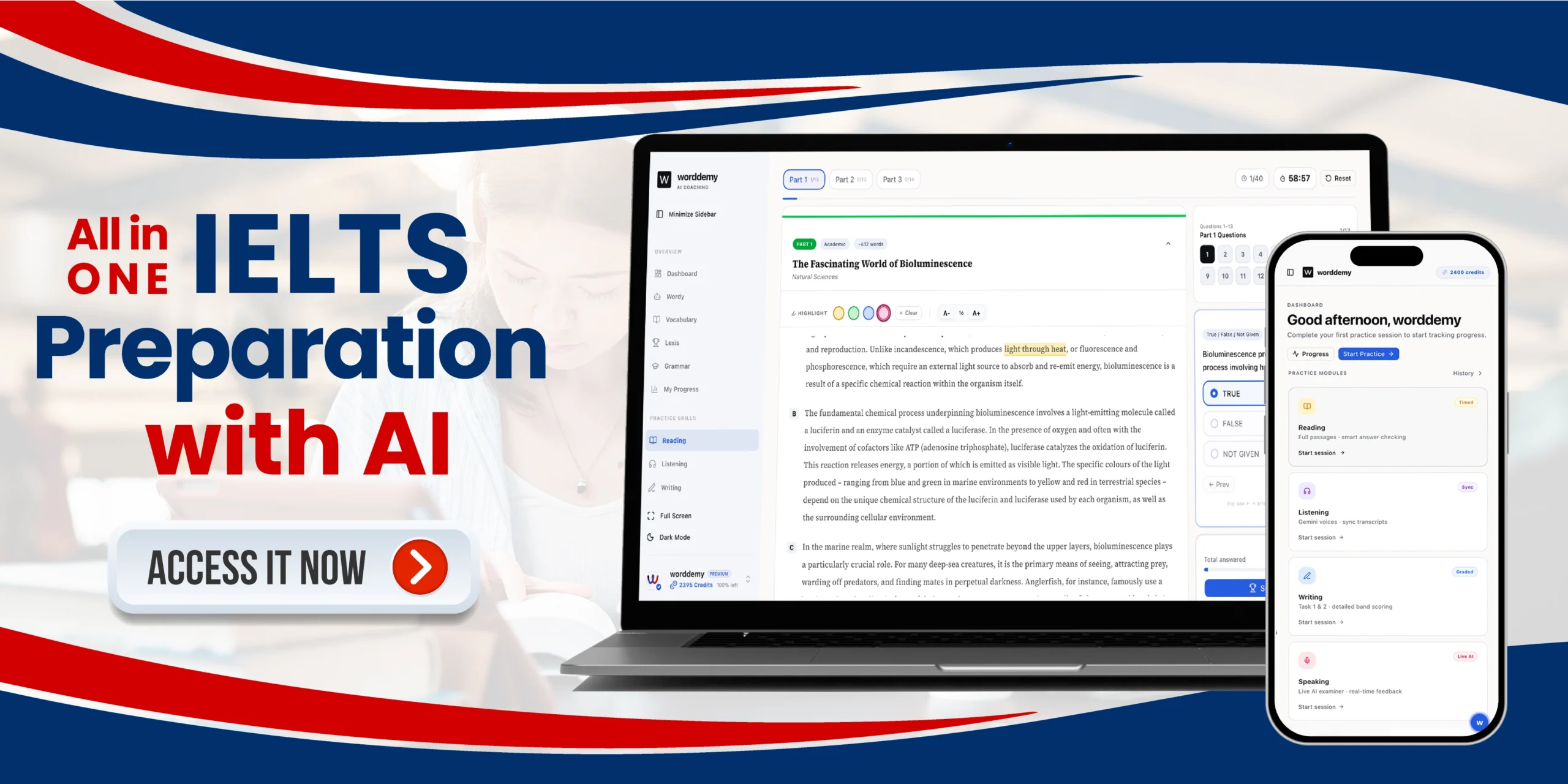
Worddemy is one option in the app category — AI feedback across Speaking, Writing, Reading, and Listening, available any time you sit down to practice. It’s worth naming early because a lot of this decision comes down to matching the tool to the specific gap in your prep, and AI feedback closes a different gap than a tutor does.
What “Faster to Band 7” Actually Depends On
Before comparing tools, it helps to be honest about what actually determines your timeline: your current band score, which skill is weakest, how much practice volume you can realistically fit in, and whether your main blocker is knowledge (you don’t know what a Band 7 answer looks like) or feedback loop speed (you know roughly what’s needed but don’t get corrected often enough to fix it).
Apps and tutors solve different pieces of that. An app can’t replace a tutor’s ability to read the room and adjust explanation style. A tutor can’t match an app’s ability to review your fifteenth practice essay at 11pm the night before your test.
What the Research Actually Says About Apps vs. Tutors
This exact comparison — self-study apps vs. human tutoring — has been studied directly, though mostly in general English learning rather than IELTS specifically, which is a real gap worth naming rather than papering over.
A 2025 research collaboration between Preply and the independent education research lab Leanlab ran parallel 12-week studies — one on one-on-one tutoring, one on a self-learning language app — and compared learner-reported outcomes. The results favored tutoring on several measures: 93% of tutoring participants reported feeling confident speaking English versus 78% of app-only participants, and 91% reported feeling more fluent versus 80% for the app group. The tutoring group’s Net Promoter Score was 65, against 6.5 for the app group (Source: Preply/Leanlab, “Navigating the limits of self-learning language apps and the value of personalized 1:1 tutoring”). Worth noting: this was an exploratory pre/post design with independent samples, not a randomized head-to-head trial, so it shows a real gap in self-reported outcomes rather than proof that tutoring causes faster gains.
Older academic research points in a similar direction for specific skills. Derwing and Munro’s 2005 research on pronunciation instruction found that individualized, face-to-face correction significantly improved learners’ pronunciation accuracy compared to less personalized methods — which tracks with why AI tools generally still struggle most with Speaking’s Pronunciation criterion specifically, not Speaking as a whole.
But apps aren’t weak across the board — they’re weak at specific things. A 2025 study in Frontiers in Education found that language-app learners’ self-reported confidence in a skill increased measurably after using generative-AI-based practice features, and noted that Duolingo-style apps have produced learning outcomes comparable to or better than classroom instruction across several country-level studies (China, Colombia, Russia, and the US) (Source: Frontiers in Education, “Mobile language app learners’ self-efficacy increases after using generative AI”). That’s a different skill set than IELTS Task 2 essay structure or Speaking Part 3 argumentation, but it does support the idea that AI-based practice moves the needle on the mechanics — vocabulary, grammar patterns, repetition-based recall — that make up a real chunk of your band score.
Apps vs. Tutors: Where Each One Actually Wins
| IELTS Prep App (e.g. Worddemy) | Human Tutor | |
|---|---|---|
| Availability | 24/7, instant feedback | Scheduled sessions only |
| Cost per session | Free–low cost, numerous attempts | Higher per-hour cost |
| Best for | High-volume practice, mechanical errors (grammar, vocabulary, structure) | Nuanced feedback, pronunciation, real-time adaptation |
| Weakest at | Pronunciation nuance, ambiguous task interpretation | Availability, cost at scale, consistency across sessions |
| Practice volume | Unlimited essays/responses | Limited by budget and tutor availability |
Is Worddemy the Right Fit — Or Is a Tutor?
Worddemy’s strength lines up with what the research above actually supports: it’s built for volume and instant feedback loops. If your Band 6 essay has recurring grammar patterns or underdeveloped Task Response, the fastest way to fix that is usually repetition with immediate correction — submit, get a criterion breakdown, revise, resubmit, dozens of times if needed, without waiting for a scheduled session or paying per attempt.
Where a tutor is genuinely the better fit: if your main blocker is Speaking pronunciation, or you’re stuck at a plateau where you don’t know why you’re stuck (which often needs a human noticing a subtle pattern across sessions, not just one response), a live tutor’s real-time adjustment is hard for any AI tool to replace right now — Worddemy included. Magoosh’s structured video-lesson format is worth a look if you want guided curriculum progression rather than open-ended practice; a service built around live sessions is the better fit if pronunciation coaching specifically is your bottleneck.
Most people who move fastest use both: AI feedback for the high-volume mechanical practice, and a smaller number of tutor sessions targeted specifically at the plateau points a tutor is best positioned to diagnose.
Addressing the Real Hesitation: “Is AI Feedback Actually Reliable Enough to Rely On?”
This is the fair objection, and it deserves a direct answer rather than a dismissal. Published research comparing LLM-based essay scoring to human IELTS/TOEFL examiners generally shows moderate-to-good correlation — one study found GPT-4’s scores correlated with human raters at r = 0.731, in a similar range to established commercial scoring systems — but not perfect agreement, and AI models tend to score conservatively at the extreme ends of the band scale rather than confidently (Source: ScienceDirect, “Large language models and automated essay scoring of English language learner writing”). Practically: treat an AI Band estimate as a strong directional signal for tracking progress and catching specific errors, not a guaranteed replica of your real exam result — which, to be fair, is also true of any single practice test, human-marked or not.
You can test the feedback quality yourself before committing to anything — submitting one Writing or Speaking response to Worddemy’s free assessment takes under 2 minutes and gives you an instant Band estimate with a criterion-by-criterion breakdown, so you can judge the specificity of the feedback firsthand.
FAQ
Can an IELTS app alone get me to Band 7? It depends on your starting point and weakest skill. Research on AI-based language practice supports real gains in mechanical areas like grammar and vocabulary; it’s less conclusively shown to fully replace the personalized correction a tutor gives, especially for Speaking pronunciation. Many test-takers combine both rather than choosing one exclusively.
Is a human tutor worth the extra cost for IELTS prep? If your main bottleneck is pronunciation, real-time speaking practice, or you’re stuck at a plateau you can’t diagnose yourself, tutoring research shows a measurable edge in learner-reported confidence and fluency outcomes. If your bottleneck is practice volume and consistent mechanical feedback, an app closes that gap at a much lower cost per attempt.
How accurate is AI feedback on IELTS Writing and Speaking? Published comparisons between LLM-based scoring and human IELTS examiners generally show moderate-to-good correlation, though not perfect agreement — accuracy varies by model, essay type, and how close a response sits to the middle of the band scale.
Try it yourself: Submit one Writing or Reading response to Worddemy’s free AI assessment — no credit card required — and see your Band estimate and criterion breakdown in under 2 minutes.