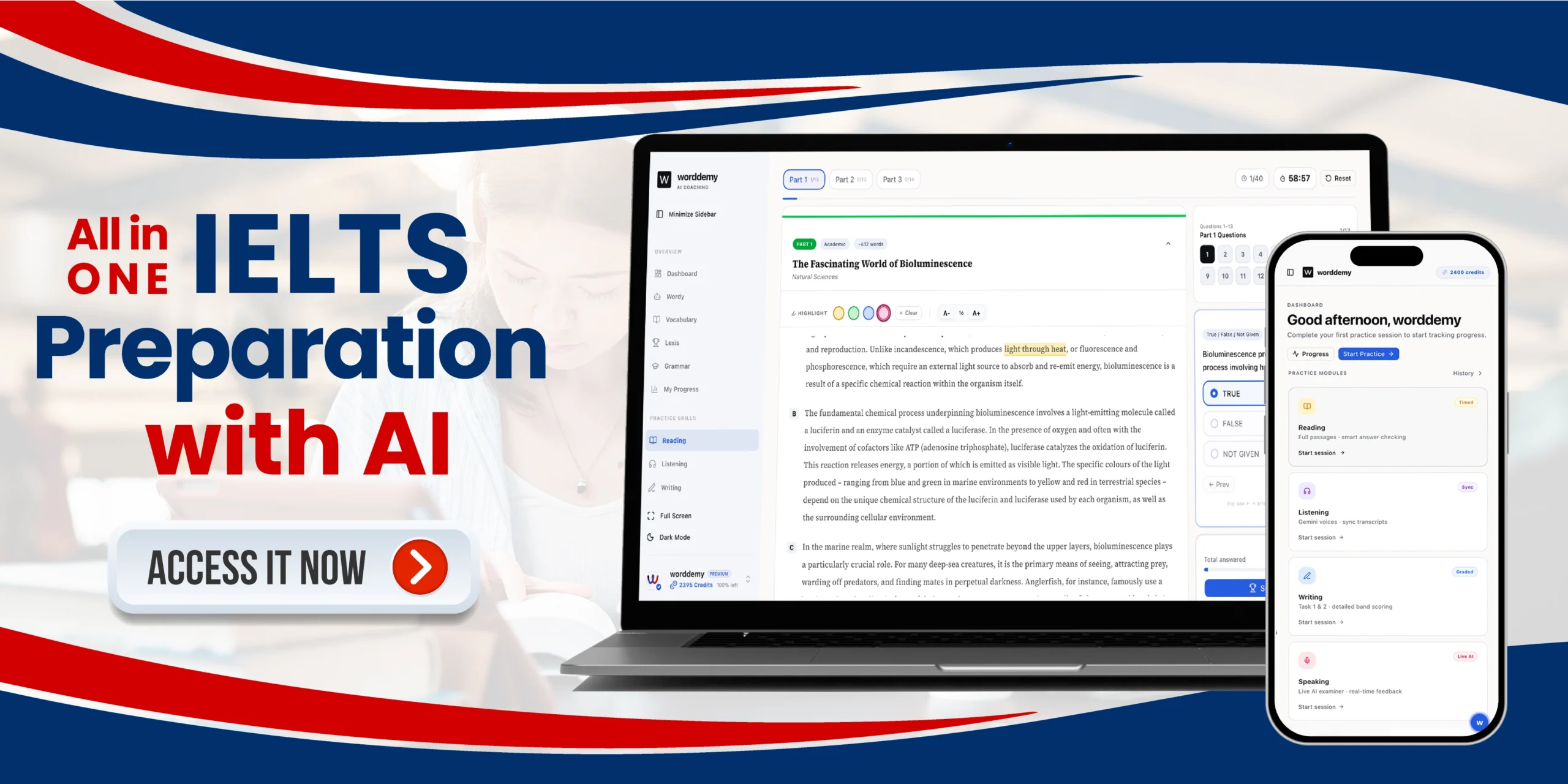
If you’re searching “IELTS online coaching,” you’re probably not looking for a definition of what coaching is — you’re trying to figure out whether paying for structured, guided help is worth it for your specific situation, versus prepping on your own with free or lower-cost tools.
That’s a real decision with real trade-offs, and it deserves a straight answer rather than a sales pitch either way.
Worddemy is one of the lower-cost options in this space worth knowing about upfront — it’s AI-powered rather than live human coaching, which matters for what follows, since the two solve overlapping but genuinely different problems.
What “IELTS Online Coaching” Actually Means
“Online coaching” usually refers to structured, instructor-led IELTS preparation delivered remotely — live or scheduled sessions with a trainer, a set curriculum, mock tests, and personalized feedback on your Writing and Speaking. It’s the online equivalent of enrolling in an in-person prep course, just without the commute. This is different from self-paced online resources (practice questions, video lessons, or AI feedback tools), which you work through on your own schedule without a live instructor guiding you.
That distinction matters because most of the value people associate with “coaching” specifically — accountability, a trainer noticing your recurring mistakes across sessions, real-time correction — comes from the live, human, structured part. A prep app can replicate some of that experience, but it’s not doing the same job, and being clear about that difference up front is more useful than pretending otherwise.
Does Coaching Actually Improve Your Score? What the Research Shows
This has been studied directly, not just claimed by coaching providers with an obvious interest in the answer. A study published in the Journal of the European Second Language Association tested a group of students on IELTS and several other English-proficiency measures, then retested them four weeks later. Between the two tests, one group underwent structured test-specific coaching using past IELTS papers; a control group took no coaching at all. The coached group showed reliable score gains over that four-week period — including participants who started at 6.0 and 6.5 — while the uncoached control group’s gain from simply retaking the test was about a tenth of a band, substantially smaller than the coached group’s improvement (Source: Journal of the European Second Language Association, “Teaching to the test: The effects of coaching on English-proficiency scores for university entry”).
That’s a genuinely useful data point: structured coaching produces measurably larger gains than simply repeating the test without guidance, over a realistic short timeframe. What that study doesn’t tell you is whether online coaching specifically outperforms in-person coaching, or how AI-based feedback compares to either — those are separate, less-studied questions, and I won’t pretend otherwise.
Online Coaching vs. AI-Powered Prep: Side by Side
| Live Online Coaching | AI-Powered Prep (e.g. Worddemy) | |
|---|---|---|
| Format | Scheduled sessions with a human instructor | Self-paced, available anytime |
| Cost | Higher — typically per-course or per-hour fees | Free or low-cost, unlimited practice attempts |
| Feedback speed | At your next scheduled session | Instant |
| Accountability | Built in — a trainer tracks your progress across sessions | Self-directed; you set your own pace |
| Best for | Structured curriculum, real-time correction, complex plateaus | High-volume practice, fast iteration, budget-conscious prep |
| Weakest at | Cost at scale, fixed scheduling | Doesn’t replicate a trainer noticing patterns across sessions or live conversational adaptation |
Is Worddemy a Substitute for Online Coaching?
Honestly — not entirely, and it’s worth being direct about that rather than stretching the comparison. If what you specifically want is a trainer who gets to know your recurring weaknesses across weeks, adjusts a curriculum to your needs, and holds you accountable to a schedule, that’s what live online coaching (through providers like the British Council’s coaching programs or IDP’s prep courses) is built for, and no AI tool — Worddemy included — fully replicates that relationship yet.
Where Worddemy fits well: as either a lower-cost starting point before you commit to paid coaching, or as a high-volume practice supplement alongside it. Since AI feedback is instant and unlimited, it’s well suited to closing mechanical gaps — grammar patterns, vocabulary range, structural issues in Writing — quickly and cheaply, freeing up paid coaching time (if you also use it) for the harder, more personalized problems a human is better positioned to solve.
Addressing the Real Hesitation: “Is Paying for Coaching Actually Worth It Over a Cheaper AI Tool?”
The honest answer depends on your specific gap. The research above supports structured coaching producing real, measurable gains over unguided practice — but it doesn’t compare coaching to AI-assisted self-study specifically, so treat any claim that one strictly outperforms the other for IELTS with appropriate skepticism, including from us. If your weak point is something mechanical and correctable through repetition — essay structure, common grammar errors, vocabulary range — a lower-cost, high-volume AI tool can close that gap efficiently before you spend money on coaching. If your weak point is something that needs a human ear (natural conversational fluency, subtle pronunciation issues, a plateau you can’t self-diagnose), that’s where paying for coaching earns its cost.
You can test where you currently stand for free before deciding — Worddemy’s free AI Writing or Speaking assessment takes under 2 minutes and gives you a Band estimate with a criterion breakdown, which can help you see whether your gap looks mechanical (where AI practice may be enough for now) or more nuanced (where coaching is likely worth the investment).
FAQ
Is online IELTS coaching worth the money? Research on structured test coaching shows it produces measurably larger score gains than unguided self-study over a comparable timeframe. Whether it’s worth the cost for you specifically depends on your current gap — coaching’s advantage is strongest for complex, hard-to-self-diagnose weaknesses rather than mechanical errors that repetition-based practice can also fix.
What’s the difference between online coaching and an AI IELTS prep app? Online coaching is live, instructor-led, and scheduled, with a human tracking your progress across sessions. AI prep apps like Worddemy are self-paced and available anytime, best suited to high-volume, instant-feedback practice rather than the personalized, adaptive relationship a coach provides.
Can I use an AI tool instead of paying for IELTS coaching? It depends on your weak areas. If your main issues are mechanical (grammar, vocabulary, structure), consistent AI-based practice can meaningfully close that gap. If you’re stuck at a plateau you can’t self-diagnose or need pronunciation-specific correction, coaching still has a real, research-supported edge.
Try it yourself: Submit one Writing or Reading response to Worddemy’s free AI assessment — no credit card required — and see your Band estimate and criterion breakdown in under 2 minutes.