
If you’re reading this at 11 p.m. with three weeks left before your test date, wondering whether an AI IELTS coach can replace a human tutor you can’t afford right now — here’s the direct answer: yes, AI coaching can meaningfully improve your Speaking, Writing, and vocabulary in the weeks before your exam, but it works best as a daily feedback loop, not a substitute for understanding the band descriptors yourself.
It’s fastest for catching grammar errors, task-response gaps, and pronunciation issues at a volume no human tutor can match on a student budget. It’s weakest at reading the emotional nuance of your speaking delivery and at giving you the kind of strategic, exam-day mindset coaching a real teacher provides.
The rest of this guide breaks down exactly where AI coaching earns its place in your prep plan, where it falls short, and how tools like app.worddemy.com fit into a realistic study routine — without the vague “practice more” advice you’ve already read a hundred times.
What Does “AI IELTS Coaching” Actually Mean?
It’s not one thing — and conflating the different types is why a lot of students end up disappointed. As of 2026, AI IELTS coaching tools generally fall into three categories:
- Writing evaluators — you paste or type your Task 1/Task 2 response, and the AI scores it against the four official criteria (Task Achievement, Coherence & Cohesion, Lexical Resource, Grammatical Range & Accuracy) and highlights specific sentences to fix.
- Speaking practice bots — you speak into your microphone, answer Part 1/2/3 style questions, and the AI transcribes your response, flags filler words, run-on sentences, and pronunciation stress errors, then gives you a rough band estimate.
- Adaptive vocabulary and grammar drills — spaced-repetition systems that track which collocations and grammar structures you keep getting wrong and resurface them until they stick.
Most serious platforms, including app.worddemy.com, combine at least two of these — usually Writing feedback plus Speaking practice — so you’re not juggling three separate apps with three separate login screens at 6 a.m. before work.
Is AI Feedback on IELTS Writing Actually Accurate?
Mostly yes for grammar and structure, partially yes for the subtler scoring criteria. Here’s the honest breakdown:
- Grammatical Range & Accuracy: AI is genuinely strong here. It will catch subject-verb agreement errors, article misuse (a/an/the), and awkward tense shifts more consistently than a tired human marker reading their 40th essay of the day.
- Lexical Resource: Good AI tools flag repeated words and suggest topic-specific collocations (e.g., swapping “big problem” for “pressing issue” in an environment essay). This is where AI coaching genuinely accelerates vocabulary growth, because you see the correction in the context of your own sentence, not a flashcard.
- Coherence & Cohesion: Decent but imperfect. AI can tell you your paragraphs lack linking devices, but it sometimes over-rewards mechanical use of “Furthermore” and “In conclusion” without checking whether your ideas actually flow logically — a nuance human examiners are trained to catch.
- Task Achievement/Response: This is the weakest spot. AI can check if you’ve addressed all parts of the prompt, but it can’t always judge whether your argument is genuinely well-developed versus just long. Don’t treat an AI band score here as gospel — treat it as a strong first-pass edit, then sanity-check against a real sample answer or a teacher’s feedback if you can get one before test day.
Practical tip: run the same essay through your AI tool twice, a day apart, without changing anything. If the band score swings more than half a band with no edits, treat the score as a rough estimate, not a precise number — and focus on the specific line-level corrections it gives you rather than the overall number.
Can AI Actually Help With IELTS Speaking, or Is It Just Transcribing Me?
A good AI speaking coach does more than transcribe — it should flag three things a transcript alone won’t show you:
- Filler word density — if you’re saying “um,” “like,” or “you know” more than roughly once every 15–20 seconds, that’s dragging your Fluency & Coherence score down even if your grammar is fine.
- Sentence length variation — Part 2 (the 2-minute long turn) rewards a mix of short and complex sentences. If an AI tool shows you that 80% of your sentences are under 8 words, that’s a concrete, fixable signal — not vague advice.
- Pronunciation stress patterns — not just whether words are “correct,” but whether you’re stressing the right syllable in multi-syllable words (a common issue for Task 3 abstract vocabulary like “sustainability” or “infrastructure”).
What AI genuinely can’t do yet: fully judge natural intonation the way a trained examiner’s ear does, or simulate the mild social pressure of speaking to an unfamiliar person — which is part of what actually gets tested. If your test date allows it, pair AI speaking drills (for repetition and volume) with at least 2–3 sessions with a real person, a study partner, or a tutor in your final two weeks, purely to rebuild that pressure tolerance.
How Should I Actually Structure a Study Plan Using AI Coaching?
Here’s a realistic 4-week structure, assuming you have 45–60 minutes a day:
Weeks 1–2 (Diagnostic + Foundation)
- Day 1: Take one full AI-scored Writing Task 2 and one AI-scored Speaking Part 2 response with zero prep, to get an honest baseline band estimate.
- Days 2–5 (rotating): One Writing Task 1 or 2 through your AI evaluator, focusing only on the top 2 recurring errors it flags — not everything at once.
- Days 6–7: Speaking drills, 3 questions per session, reviewing AI feedback on filler words and sentence variety.
Weeks 3 (Targeted Correction)
- Focus entirely on your two weakest scoring criteria from Week 1–2 data. If your AI tool tracks error patterns over time (worddemy does this through repeated writing/speaking sessions), use that history — don’t just start from scratch every session.
Week 4 (Simulation + Human Check-in)
- Two full timed mock tests (Writing + Speaking) under real time pressure: 60 minutes for the Writing section, roughly 11–14 minutes for Speaking.
- If possible, get one session reviewed by a human — a tutor, a fluent friend, or a study group — specifically to catch what the AI might be missing on Task Achievement and natural delivery.
Where Does app.worddemy.com Fit Into This?
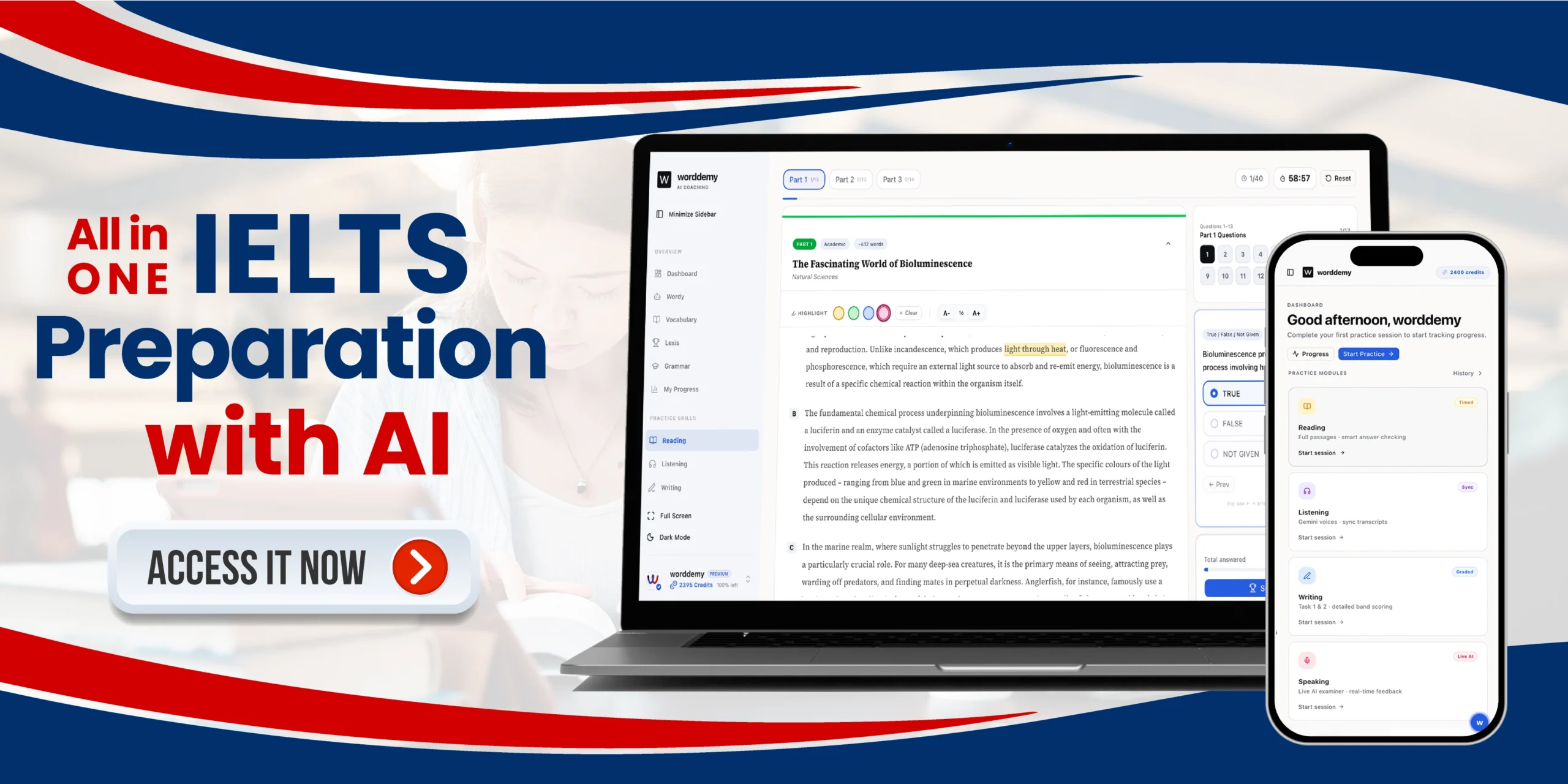
Worddemy app is built around the daily-feedback-loop model described above: you get AI-scored Writing evaluations against the actual band descriptors, Speaking practice with transcript and filler-word analysis, and vocabulary drills that adapt based on the specific words and structures you personally struggle with — rather than a generic word list everyone gets. If your main obstacle right now is consistency (fitting in daily practice around work, university, or family) more than access to a human tutor, it’s worth building your plan around it and adding a human check-in only in your final week, as outlined above.
Is AI Coaching Enough on Its Own, or Do I Still Need a Human Tutor?
Depends on your starting band and your timeline:
- If you’re already around Band 6.5–7 and need to polish — AI coaching alone can likely get you the rest of the way, since your errors at this level are usually specific and mechanical (a few recurring grammar slips, slightly repetitive vocabulary) — exactly what AI tools catch well.
- If you’re at Band 5–5.5 and have less than 4 weeks — AI coaching should be your daily driver for volume, but budget for at least 2–3 sessions with a human tutor to correct foundational issues (like Task Response structure) that AI evaluators tend to under-flag.
- If you have 2+ months — mix both from day one. Use AI for daily reps and error tracking; use a human tutor every 1–2 weeks for strategic check-ins and mock interview pressure.
A Quick Note on Accuracy and Official Rules
AI band score estimates are a study tool, not an official prediction — they can vary from your actual test result, sometimes by half a band or more, especially at the higher end of the scale (Band 7.5+) where scoring becomes more subjective even among human examiners. Test format details, accepted ID documents, and computer-delivered vs. paper-based test availability also vary by country and test center, so always double-check current requirements on the official IELTS website for your region before test day.
Have you tried an AI coaching tool for your IELTS prep — did it actually change your band score, or did it just feel productive? Drop your experience in the comments below; I read and reply to all of them, and it genuinely helps other readers figure out if AI coaching fits their situation.

Leave a Reply